

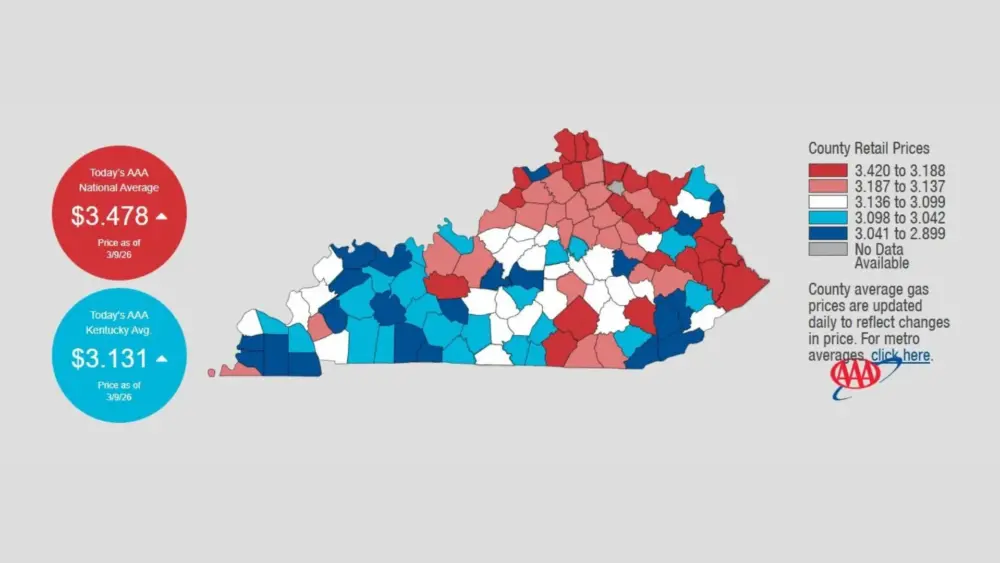
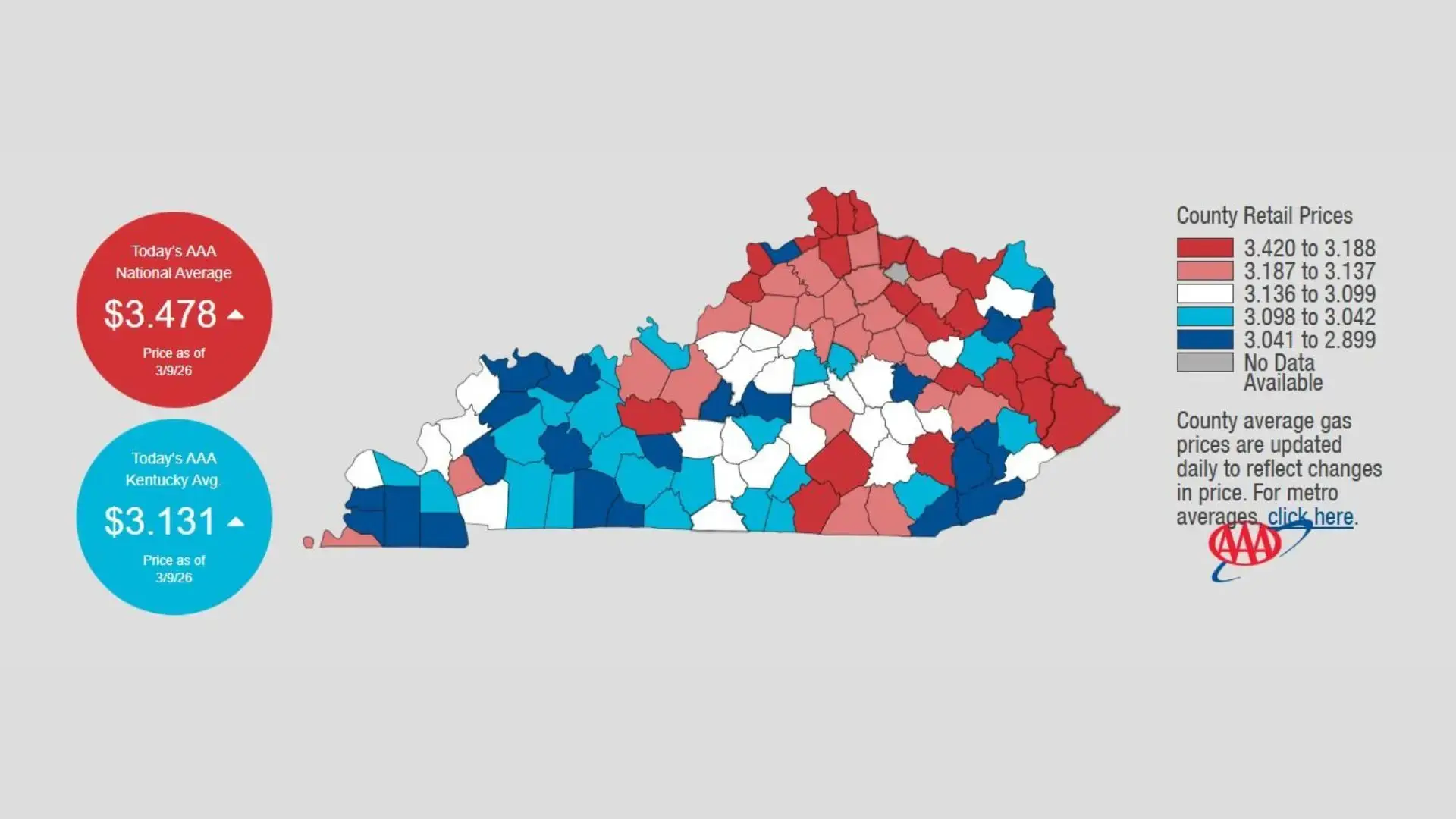
It should be no surprise that gas prices in west central Kentucky have jumped sharply over the past week.
According to the AAA East Central Gas Price Report, released every Monday as a monitor to the region, the average here in the News Edge listening area is now $3.09 per gallon, up 47 cents from last week’s average of $2.61.
A year ago, drivers were paying about $2.58 per gallon.
Prices across parts of Kentucky today include $3.07 in Bowling Green, $3.17 in Elizabethtown, $3.14 in Louisville, $3.00 in Owensboro and $3.06 in Paducah.
Here, it’s $3.11 in Trigg County, $3.07 in Christian County, $3.05 in Todd County, $3.01 in Caldwell County and $3.06 in Hopkins County.
Across the country, the average price for regular gasoline has risen 48 cents in the past week to $3.47 per gallon, the highest level since the summer of 2024.
Analysts say rising crude oil prices—now above $100 per barrel—are being driven partly by tensions in the Middle East and the pivotal Strait of Hormuz, which is a vital waterway connecting the Persian Gulf to the Gulf of Oman. Approximately 20% of the world’s oil and liquefied natural gas passes through there daily.
Furthermore, crude oil typically accounts for 50–60% of the cost of gasoline, meaning increases at the barrel level quickly push prices higher at the pump. And according to several sources, last week’s jump in oil prices per barrel was the largest in American history.
It’s also worth noting that since 2018, the United States has surpassed both Russia and Saudi Arabia as the world’s top producer in oil. Since August 2021, the U.S. has also consistently exported more oil and petroleum products than it imports, making it a net petroleum exporter — and a beneficiary of high oil prices.
Per the U.S. Energy Information Administration, this country became a net exporter of petroleum for the first time in decades in 2020, after years of increasing domestic production, particularly from shale oil. Prior to this, the U.S. had been a net importer for most of the 20th century, with imports peaking in 2005. Even after becoming a net exporter, the U.S. continues to import some crude oil to meet refinery needs and optimize costs.
Seasonal factors are also contributing to the spike, as spring travel demand increases and refineries begin producing summer-blend gasoline, which is more expensive to manufacture.
New data from the U.S. Energy Information Administration shows gasoline demand decreased slightly last week, while production increased to about 9.3 million barrels per day. U.S. crude oil inventories also rose to 439.3 million barrels, which remains about 3% below the five-year average for this time of year.
Meanwhile, the national average cost for electricity at public EV charging stations remains unchanged at 39 cents per kilowatt hour — a sign of market stability in unstable times.